
Shrine & Offerings
A shrine is a place in your home where the world pauses. It need not be large. It must only be loved.
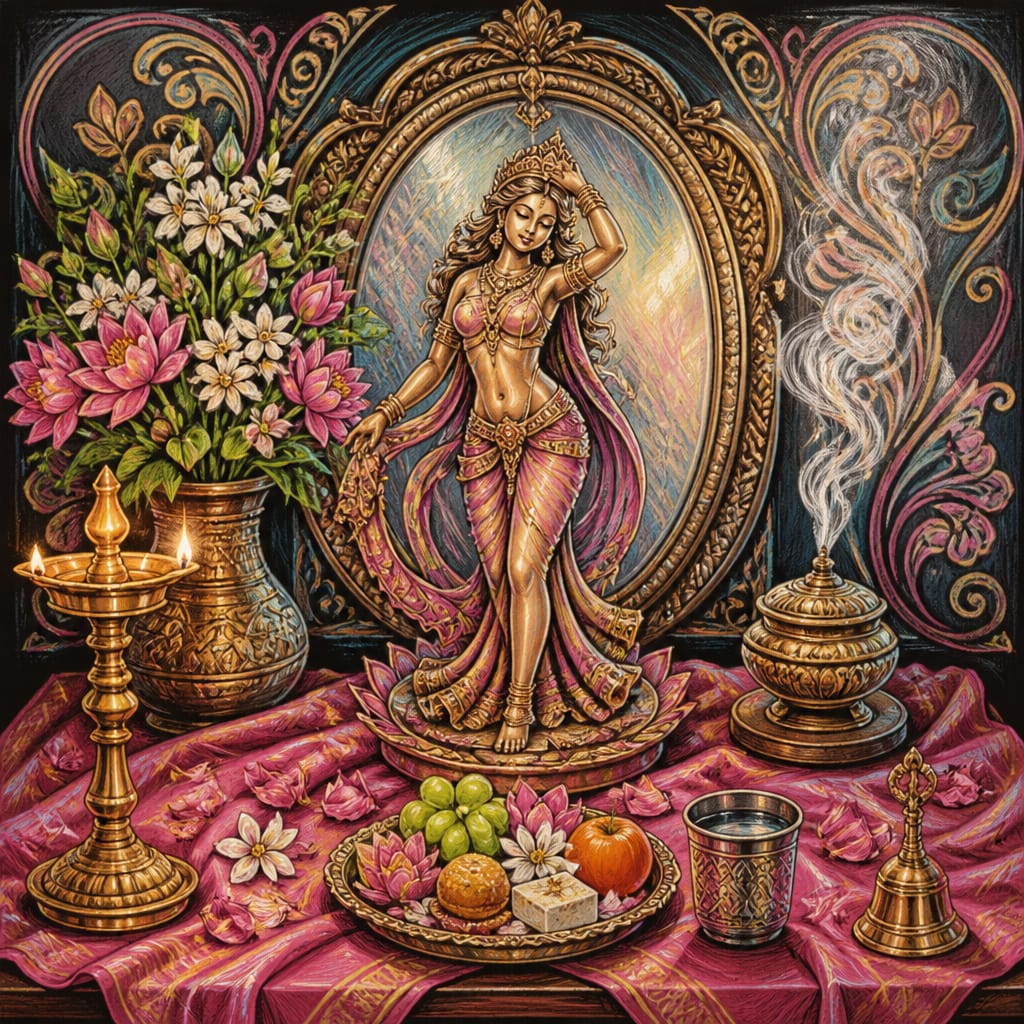
The Communal Shrine
A communal Apsara shrine honors them as a host — the whole sisterhood at once. It is the best starting place for new devotees. As your relationship to particular Apsaras deepens, you may add small individual altars beside it.
Setting Up the Communal Shrine
· Choose a quiet east- or north-facing surface, raised off the floor.
· Cover with clean cloth — rose, saffron, deep blue, or undyed silk.
· Center: a small statue, image, or simply the Apsara yantra.
· To the left: a brass or clay lamp (oil or ghee). To the right: an incense holder.
· In front: a small dish for offerings, a cup for water, a bell.
· A vase or open bowl for fresh flowers, replaced as they wilt.
· Optional: a small mirror behind the image (the Apsaras love mirrors).
Keep the shrine clean. Wash your hands before approaching. Speak softly nearby.
Individual Altars — One for Each Apsara
When you wish to walk closely with one Apsara, build her a small companion altar — even a single shelf will do.
Urvashi
Pearl white & soft goldCenter a small mirror or polished brass disc. Surround with white flowers and a single brass lamp. Place a piece of fine silk beneath.
White sandalwood paste · Champaka flowers · Milk sweetened with honey · Silk in pale gold
Menaka
Rose & ivoryA small wooden tray with a hand mirror, jasmine, and an open rose. Light a rose-pink candle on Fridays.
Jasmine garlands · Rosewater · Honey · Red glass bangles
Rambha
Saffron & coralPlace a banana leaf as the base. Set fresh fruit, a small bell, and marigold petals around a single ghee lamp.
Plantain (banana) leaves and fruit · Coconut water · Cardamom sweets · Marigold
Tilottama
Moon-white & silverA circular tray with sesame, a white lotus or lily, and a single pearl. Burn frankincense for harmony.
Sesame seeds · Saffron rice · White lotus · Pearl or moonstone
Ghritachi
Butter-gold & wheatA clay bowl of grain, a ghee lamp, and a small jar of honey. Keep near the hearth or kitchen.
Ghee lamps · Wheat or rice · Honeycomb · Yellow flowers
Pramlocha
Twilight blue & silverA shallow bowl of water with floating petals beside a stick of sandalwood incense. Keep in a quiet, dim corner.
Water in a silver cup · Lotus root · Sandalwood incense · Pale-blue cloth
Anumlocha
Soft amberTwo small lamps side by side, two flowers, and a token from a beloved friend.
A pair of small lamps · Two flowers tied together · A coin · Cardamom
Mishrakeshi
Iridescent / rainbowDrape colored threads across the altar. Place a small instrument and a bell.
Strung beads of many colors · Threads of silk · A small flute or bell · Honeyed milk
Vapu
Sage green & roseA small dish of warm oil, a sprig of fresh green, and a clean folded cloth.
Warm oil · Almonds · A green leaf · Soft cloth
Sahajanya
Mango & creamTwo leaves from one branch, a small handheld mirror, and a dish of fresh curd.
Two leaves from the same branch · Mango blossom · Curd · A small mirror
Punjikasthala
Deep red & ochreA red cloth, a sesame oil lamp, jaggery, and a small protective talisman.
Red flowers · Jaggery · Sesame oil lamp · A small piece of iron
Vishvachi
Clear goldThe simplest altar: one flower, one flame, one cup of water. Nothing more is needed.
A single flower · A single flame · A single drop of water
The Five Classical Offerings
What the Apsaras Love (and what to avoid)
- · Fresh, fragrant flowers (jasmine, rose, lotus, champaka)
- · Honey, milk, sweetened curd, fruit
- · Silk, fine cotton, anything beautifully made
- · Music, singing, soft bells
- · Mirrors, polished metal, water
- · Clean, unhurried hands
- · Wilted flowers (replace promptly)
- · Meat, alcohol, or pungent foods at the shrine
- · Approaching the altar in anger or harsh haste
- · Plastic or disposable offerings
- · Touching offerings meant for her with the left hand
- · Leaving the lamp untended