
Yantras
A yantra is a body for a presence. Drawn with attention and consecrated with breath, it becomes a place where the Apsara may comfortably alight.
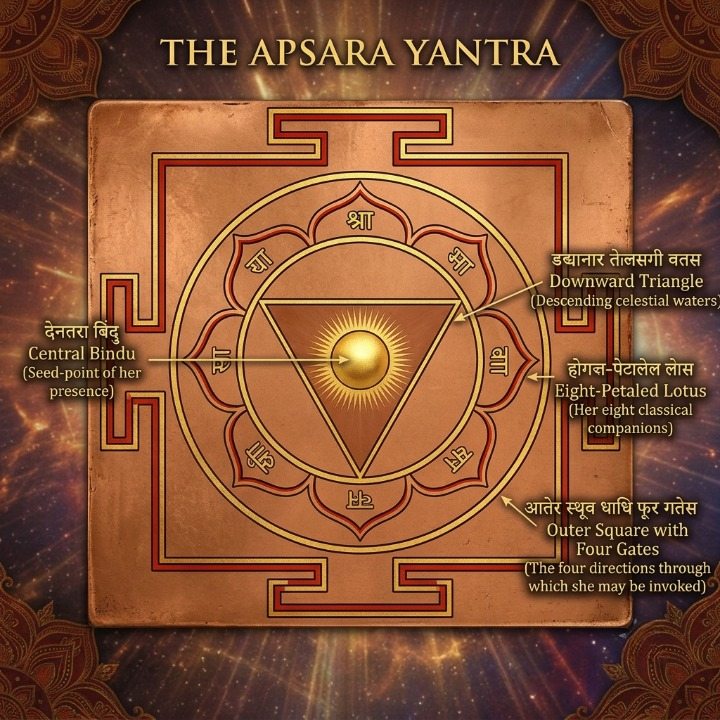
The Apsara Yantra
The general Apsara yantra is built upon a central bindu (the seed-point of her presence), surrounded by a downward triangle (the descending celestial waters), an eight-petaled lotus (her eight classical companions), and an outer square with four gates (the four directions through which she may be invoked).
Structure, From Center Outward
- 01BinduA single dot at the exact center. This is the Apsara herself — undifferentiated, complete.
- 02Inner TriangleA downward-pointing triangle around the bindu — the descent of the celestial into the earthly.
- 03HexagramTwo interlocking triangles, the meeting of heaven and earth, the embrace of devotee and deity.
- 04Eight-Petaled LotusEach petal a companion Apsara. Inscribe her bija inside if working with one in particular.
- 05Sixteen-Petaled LotusThe sixteen forms of beauty (sound, scent, touch, taste, etc.) over which she has dominion.
- 06BhupuraAn outer square with four T-shaped gates — the protective walls of the temple, opening to each direction.
Drawing & Consecrating Your Yantra
✶ Choose a quiet morning. Bathe. Sit facing east or north.
✶ Use paper with gold or saffron ink, or copper / silver plate engraved with a fine tool.
✶ Draw from the center outward — never from the edges in.
✶ As you draw each layer, breathe slowly and silently repeat Om.
✶ When complete, anoint each gate with sandalwood. Place a single flower on the bindu.
✶ Chant the Apsara's mantra 108 times to seat her presence in the yantra.
✶ Wrap in silk when not in use. Never let it fall or be touched casually.